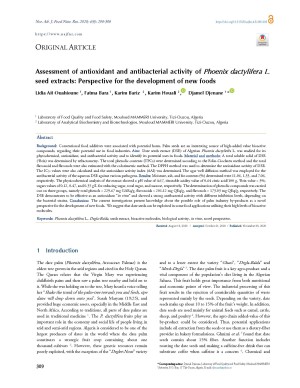
Assessment of Antioxidant and Antibacterial Activity of Phoenix dactylifera L. Seed Extracts: Perspective for the Development of New Foods
Copyright © 2020 Authors

This work is licensed under a Creative Commons Attribution 4.0 International License.
- Attribution — You must give appropriate credit, provide a link to the license, and indicate if changes were made.
- No additional restrictions — You may not apply legal terms or technological measures that legally restrict others from doing anything the license permits.





Background: Conventional food additives were associated with potential harm. Palm seeds are an interesting source of high-added value bioactive compounds, regarding their potential use in food industries.
Aims: Date seeds extract (DSE) of Algerian Phoenix dactyliefra L. was studied for its phytochemical, antioxidant, and antibacterial activity and to identify its potential uses in foods.
Material and methods: A total soluble solid of DSE (°Brix) was determined by refractometry. The total phenolic contents (TPCs) were determined according to the Folin-Cioclateu method and the total flavonoid and flavonols were also estimated with colorimetric method. The DPPH method was used to determine the antioxidant activity of DSE. The IC50 values were also calculated and the antioxidant activity index (AAI) was determined. The agar well diffusion method was employed for the antibacterial activity of the aqueous DSE against various pathogens.
Results: Moisture, ash, and fat contents (%) determined were 11.06, 1.33, and 7.06, respectively. The physicochemical analysis of the extract showed a pH value of 4.67, titratable acidity value of 0.64 citric acid/100 g, °Brix value = 3%, sugars values of 0.12, 0.47, and 0.35 g/L for reducing sugar, total sugar, and sucrose, respectively. The determination of phenolic compounds was carried out on three groups, namely total phenols = 229.67 mg GAEq/g, flavonoids = 201.12 mg QEq/g, and flavonols = 173.03 mg QEq/g, respectively. The DSE demonstrates to be effective as an antioxidant “in vitro” and showed a strong antibacterial activity with different inhibition levels, depending on the bacterial strains.
Conclusion: The current investigations present knowledge about the possible role of palm industry by-products as a novel perspective for the development of new foods. We suggest that date seeds can be exploited in some food applications utilizing their high levels of bioactive molecules.
Keywords
How to Cite
1. Adeosun, A. M., Oni, S. O., Ighodaro, O. M., Durosinlorun, O. H., & Oyedele, O. M. (2016). Phytochemical, minerals and free radical scavenging profiles of Phoenix dactilyfera L. seed extract. Journal of Taibah University Medical Sciences, 11 (1), 1-6. https://doi.org/10.1016/j.jtumed.2015.11.006
2. Bedjaoui, H., & Benbouza, H. (2020). Assessment of phenotypic diversity of local Algerian date palm (Phoenix dactylifera L.) cultivars. Journal of the Saudi Society of Agricultural Sciences, 19 (1), 65-75. https://doi.org/10.1016/j.jssas.2018.06.002
3. Khali, M., Boussena, Z., & Boutekrabt, L. (2015). Effet de l’incorporation de noyaux de dattes sur les caractéristiques technologiques et fonctionnelles de la farine de blé tendre. Revue Nature et Technologie, 7 (1), 15-25.
4. Al-Farsi, M. A., & Lee, C. Y. (2008). Optimization of phenolics and dietary fiber extraction from date seeds. Food Chemistry, 108 (3), 977-985. https://doi.org/10.1016/j.foodchem.2007.12.009
5. Ghnimi, S., Umer, S., Karim, A., & Kamal-Eldin, A. (2017). Date fruit (Phoenix dactylifera L.): An underutilized food seeking industrial valorization. NFS Journal, 6, 1-10. https://doi.org/10.1016/j.nfs.2016.12.001
6. Rahman, M., Kasapis, S., Al-Kharusi, N., Al-Marhubi, I., & Khan, A. (2007). Composition characterisation and thermal transition of date pits powders. Journal of Food Engineering, 80 (1), 1-10. https://doi.org/10.1016/j.jfoodeng.2006.04.030
7. Hamada, J., Hashim, I., & Sharif, F. (2002). Preliminary analysis and potential uses of date pits in foods. Food Chemistry, 76 (2), 135-137. https://doi.org/10.1016/s0308-8146(01)00253-9
8. Aldhaheri, A., Alhadrami, G., Aboalnaga, N., Wasfi, I., & Elridi, M. (2004). Chemical composition of date pits and reproductive hormonal status of rats fed date pits. Food Chemistry, 86 (1), 93-97. https://doi.org/10.1016/j.foodchem.2003.08.022
9. Besbes, S., Blecker, C., Deroanne, C., Drira, N., & Attia, H. (2004). Date seeds: Chemical composition and characteristic profiles of the lipid fraction. Food Chemistry, 84 (4), 577-584. https://doi.org/10.1016/s0308-8146(03)00281-4
10. Al-Farsi, M., Alasalvar, C., Al-Abid, M., Al-Shoaily, K., Al-Amry, M., & Al-Rawahy, F. (2007). Compositional and functional characteristics of dates, syrups, and their by-products. Food Chemistry, 104 (3), 943-947. https://doi.org/10.1016/j.foodchem.2006.12.051
Similar Articles
- Biochemical and Microbiological Characterization of “Soumbara” from African Locust Bean (Parkia biglobosa) Seeds Consumed in Abidjan, Côte d’Ivoire
- Effects of Extrusion on Nutritional and Non-Nutritional Properties in the Production of Multigrain Ready to Eat Snacks Incorporated with NUA45 Beans
- Effect of Peanut-Skin Fortification on Oil Separation and Consumer Acceptance of Sesame Butter
- Effect of Citric Acid and Brine Pre-Treatment on Deodorization of Green Banana Flour
- Rapid Survey on Lifestyle Changes and Body Weight Gain Among Algerians During COVID-19 Lockdown
- Regulation of Food Supplements in Algeria: Current Situation, Issues, and Perspectives.
- Effect of Incorporating Lippia javanica (Zumbani) on Physical, Nutritional, Microbiological, and Sensory Properties of Instant Soup Mix Powder
- Natural Pectin Sources, Extraction Methods, Chemical Composition, and Emerging Applications in Food Systems: A Systematic Review
- Effect of Concentration of Allium cepa and Pimpinella anisum Powders on the Oxidative Stability of Oils Extracted from Peanut Cakes
- Determination of Sensory, Microbiological and Antioxidant Properties of Tortilla Added with Roselle Decoction Calyxes Powder
You may also start an advanced similarity search for this article.

 NAJFNR is licensed under