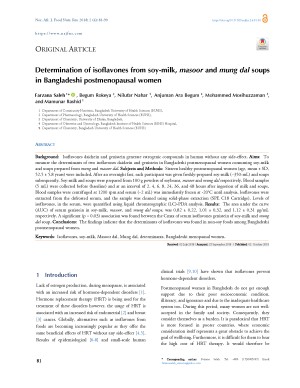
Determination of Isoflavones from Soy-Milk, Masoor and Mung Dal Soups in Bangladeshi Postmenopausal Women
Copyright © 2018 Authors

This work is licensed under a Creative Commons Attribution 4.0 International License.
- Attribution — You must give appropriate credit, provide a link to the license, and indicate if changes were made.
- No additional restrictions — You may not apply legal terms or technological measures that legally restrict others from doing anything the license permits.





Background: Isoflavones daidzein and genistein generate estrogenic compounds in human without any side-effect.
Aims: To measure the determinants of two isoflavones daidzein and genistein in Bangladeshi postmenopausal women consuming soy-milk and soups prepared from mung and masoor dal.
Participants and Methods: Sixteen healthy postmenopausal women (age, mean±SD, 52.5±5.8 years) were included. After an overnight fast, each participant was given freshly-prepared soy-milk (~350-mL) and soups subsequently. Soy-milk and soups were prepared from 100 g powders of soybeans, masoor and mung dal respectively. Blood samples (5 mL) were collected before (baseline) and at an interval of 2, 4, 6, 8, 24, 36, and 48 hours after ingestion of milk and soups. Blood samples were centrifuged at 1200 rpm and serum (~2 mL) was immediately frozen at -20°C until analysis. Isoflavones were extracted from the defrosted serum, and the sample was cleaned using solid-phase extraction (SPE C18 Cartridge). Levels of isoflavones, in the serum, were quantified using liquid chromatographic (LC)-PDA analysis.
Results: The area under the curve (AUC) of serum genistein in soy-milk, masoor, and mung dal soups, was 0.82 ±0.22, 1.01 ±0.32, and 1.12 ±0.31 µg/mL respectively. A significant (P= 0.03) association was found between the Cmax of serum isoflavones genistein of soy-milk and mung dal soup. Conclusions: The findings indicate that the determinants of isoflavones was found in non-soy foods among Bangladeshi postmenopausal women. Isoflavones daidzein and genistein generate estrogenic compounds in human without any side-effect. Aims: To measure the determinants of two isoflavones daidzein and genistein in Bangladeshi postmenopausal women consuming soy-milk and soups prepared from mung and masoor dal. Methods and Material: Sixteen healthy postmenopausal women (age, mean±SD, 52.5±5.8 years) were included. After an overnight fast, each participant was given freshly-prepared soy-milk (~350-mL) and soups subsequently. Soy-milk and soups were prepared from 100 g powders of soybeans, masoor and mung dal respectively. Blood samples (5 mL) were collected before (baseline) and at an interval of 2, 4, 6, 8, 24, 36, and 48 hours after ingestion of milk and soups. Blood samples were centrifuged at 1200 rpm and serum (~2 mL) was immediately frozen at -20°C until analysis. Isoflavones were extracted from the defrosted serum, and the sample was cleaned using solid-phase extraction (SPE C18 Cartridge). Levels of isoflavones, in the serum, were quantified using liquid chromatographic (LC)-PDA analysis. Results: The area under the curve (AUC) of serum genistein in soy-milk, masoor, and mung dal soups, was 0.82 ±0.22, 1.01 ±0.32, and 1.12 ±0.31 µg/mL respectively. A significant (P= 0.03) association was found between the Cmax of serum isoflavones genistein of soy-milk and mung dal soup.
Conclusions: The findings indicate that the determinants of isoflavones was found in non-soy foods among Bangladeshi postmenopausal women.
Keywords
How to Cite
1. van der Schouw, Y. T., van der Graaf, Y., Steyerberg, E. W., Eijkemans, M. J. C., & Banga, J. D. (1996). Age at menopause as a risk factor for cardiovascular mortality. The Lancet, 347(9003), 714–718. https://doi.org/10.1016/S0140-6736(96)90075-6
2. Bjarnason, N. H. (2005). Endometrial cancer and hormone-replacement therapy. The Lancet, 366(9481), 200–201. https://doi.org/10.1016/S0140-6736(05)66455-0
3. Million Women Study Collaborators. (2003). Breast cancer and hormone-replacement therapy in the Million Women Study. The Lancet, 362(9382), 419–427. https://doi.org/10.1016/S0140-6736(03)14065-2
4. Knight, D. C., & Eden, J. A. (1996). A review of the clinical effects of phytoestrogens. Obstetrics & Gynecology, 87(5), 897–904. https://doi.org/10.1016/0029-7844(96)00020-8
5. Yuan, J. P., Wang, J. H., & Liu, X. (2007). Metabolism of dietary soy isoflavones to equol by human intestinal microflora—Implications for health. Molecular Nutrition & Food Research, 51(7), 765–781. https://doi.org/10.1002/mnfr.200600262
6. Lee, H. P., Gourley, L., Duffy, S. W., Estève, J., Lee, J., & Day, N. E. (1991). Dietary effects on breast-cancer risk in Singapore. The Lancet, 337(8751), 1197–1200. https://doi.org/10.1016/0140-6736(91)92867-2
7. Setchell, K. D. R. (1995). Non-steroidal estrogens of dietary origin: Possible roles in health and disease, metabolism and physiological effects. Proceedings of the Nutrition Society of New Zealand, 20, 1–21.
8. Cassidy, A. (1996). Physiological effects of phyto-oestrogens in relation to cancer and other human health risks. Proceedings of the Nutrition Society, 55(1B), 399–417. https://doi.org/10.1079/PNS19960038
9. Anderson, J. W., Johnstone, B. M., & Cook-Newell, M. E. (1995). Meta-analysis of the effects of soy protein intake on serum lipids. New England Journal of Medicine, 333(5), 276–282. https://doi.org/10.1056/NEJM199508033330502
10. Kurzer, M. S. (2000). Hormonal effects of soy isoflavones: Studies in premenopausal and postmenopausal women. The Journal of Nutrition, 130(3), 660S–661S. https://doi.org/10.1093/jn/130.3.660S
Similar Articles
- Effects of fermentation period and soybean flour supplementation on the glycemic indices and starch digestibility of biofortified provitamin A cassava meal
- Anti-Inflammatory Activity of Doum Palm Fruit Extract Used in the Management of Benign Prostatic Hyperplasia
- Quality Evaluation and Storage Stability of Low-Fat Chin-Chin Formulated with Wheat-Soybean Residue (Okara) Flour Blends
- Evaluation of Nutritional Status Among COVID-19 Patients Admitted to the Intensive Care Unit in Jeddah, Saudi Arabia: A Cross-Sectional Observational Study
- Effect of Sunlight Exposure and Packaging Materials on the Quality and Oxidative Stability of Commercial Vegetable Oils in Cameroon
- Phenol Content, Potential Antioxidant and Anti-Urolithic Effects of Fruit and Leaf Extracts from Algerian Capparis spinosa L.
You may also start an advanced similarity search for this article.

 NAJFNR is licensed under