Nutritional Properties and Plausible Benefits of Pearl millet (Pennisetum glaucum) on Bone Metabolism and Osteoimmunology: A Mini-Review
Copyright © 2020 Authors

This work is licensed under a Creative Commons Attribution 4.0 International License.
- Attribution — You must give appropriate credit, provide a link to the license, and indicate if changes were made.
- No additional restrictions — You may not apply legal terms or technological measures that legally restrict others from doing anything the license permits.


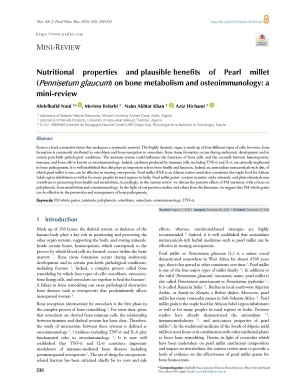
Bone is a hard connective tissue that undergoes a systematic renewal. This highly dynamic organ is made up of four different types of cells, however, bone formation is commonly attributed to osteoblasts and bone resorption to osteoclasts. Bone tissue formation occurs during embryonic development and in certain post-birth pathological conditions. The immune system could influence the functions of bone cells, and the crosstalk between hematopoietic, immune, and bone cells is known as osteoimmunology. Indeed, cytokines produced by immune cells, including TNF-α and IL-6, are critically implicated in bone pathogenesis. It is well established that diet plays an important role in bone health and function. Indeed, antioxidant nutraceuticals-rich diet, of which pearl millet is one, can be effective in treating osteoporosis. Pearl millet (PM) is an African native cereal that constitutes the staple food for African Sahel region inhabitants as well as for many peoples in rural regions in India. Pearl millet grains content in amino acids, minerals, and phytochemicals may contribute to promoting bone health and metabolism. Accordingly, in the current review, we discuss the putative effects of PM nutrients, with a focus on polyphenols, on bone metabolism and osteoimmunology. In the light of our previous studies and others from literature, we speculate that PM whole grains may be effective in the prevention and management of bone pathogenesis.
Keywords
How to Cite
Lorenzo J, Horowitz M, Choi Y, Takayanagi H, Schett G. Osteoimmunology: Interactions of the Immune and Skeletal Systems. Academic Press, 2nd Edition: 2015: pp 376. ISBN-13: 978-0128005712
2. Katagiri T, Tsukamoto S, Osawa K, Kokabu S. Ligand–Receptor Interactions and Their Implications in Delivering Certain Signaling for Bone Regeneration. In: A Tissue Regeneration Approach to Bone and Cartilage Repair. Springer; 2015:1-15.
3. Bellido, T., Plotkin, L. I., & Bruzzaniti, A. (2019). Bone Cells. Basic and Applied Bone Biology, 37 55. https://doi.org/10.1016/b978-0-12-813259-3.00003-8
4. Sinaki M, Pfeifer M. Non-Pharmacological Management of Osteoporosis: Exercise, Nutrition, Fall and Fracture Prevention. Springer: 2017: pp 262. ISBN-13 : 978-3319852973
5. Charles, J. F., Nakamura, M. C., & Humphrey, M. B. (2019). Bone and the Immune System (Osteoimmunology). Basic and Applied Bone Biology, 333 347. https://doi.org/10.1016/b978-0-12-813259-3.00017-8
6. Lian, J. B., Gravallese, E. M., & Stein, G. S. (2011). Osteoblasts and their Signaling Pathways. Osteoimmunology, 101 140. https://doi.org/10.1016/b978-0-12-375670-1.10005-6
7. Wang, T., & He, C. (2020). TNF-α and IL-6: The Link between Immune and Bone System. Current drug targets, 21(3), 213–227. https://doi.org/10.2174/1389450120666190821161259
8. Kelly L, Kelly HB. The Healthy Bones Nutrition Plan and Cookbook: How to Prepare and Combine Whole Foods to Prevent and Treat Osteoporosis Naturally. Chelsea Green Publishing: 2016: pp 304. ISBN-13 : 978-1603586245
9. Winchell, F., Brass, M., Manzo, A., Beldados, A., Perna, V., Murphy, C., Stevens, C., & Fuller, D. Q. (2018). On the Origins and Dissemination of Domesticated Sorghum and Pearl Millet across Africa and into India: a View from the Butana Group of the Far Eastern Sahel. African Archaeological Review, 35(4), 483 505. https://doi.org/10.1007/s10437-018-9314-2
10. Amadou, I., Gounga, M., & Le, G.-W. (2013, May 1). Millets: Nutritional composition, some health benefits and processing - A review. Emirates Journal of Food and Agriculture, 25(7), 501-508. https://doi.org/https://doi.org/10.9755/ejfa.v25i7.12045
Similar Articles
- A review of traditional grain-based complementary foods for children aged 6-23 months in selected African countries
- Climate-Resilient Crops as Gluten-Free Substitutes: A Systematic Review of the Nutritional, Technofunctional, and Rheological Properties of Sorghum, Pearl Millet, and Amaranth
- Critical Evaluation of the Discrepancy Between Whole and Refined Foods: Nutritional Implications
- Exploring the Antioxidant Potential and HPLC Profile of Fenugreek (Trigonella foenum-graecum L.) Seed Extracts
- Influence of Grain Size on the Agglomeration and Quality of Fine Couscous Derived from Decorticated White Sorghum Bicolor L.
- Traditional Cereals-Based Foods in North African Cuisine: Wheat as the Cornerstone
- Biological and functional properties of vine leaves
- Association Between Dietary Diversity and Nutritional Status of Children Aged 6-59 Months in the Tamale Metropolis
- Comparative Study of the Physicochemical, Phenolic, Mineral, and Antioxidant Profiles of Wild and Cultivated Carob (Ceratonia siliqua) Pulp from Morocco
- Statistical Optimization of Microwave-Assisted Extraction of Phytochemicals from Retama raetam (White Weeping Broom) Twigs and their Biological Properties
You may also start an advanced similarity search for this article.

 NAJFNR is licensed under