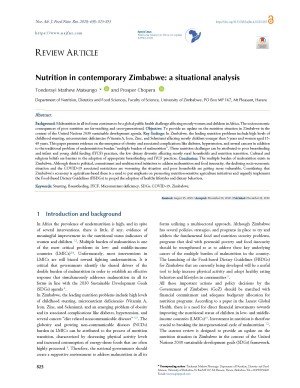
Nutrition in Contemporary Zimbabwe: A Situational Analysis
Copyright © 2020 Authors

This work is licensed under a Creative Commons Attribution 4.0 International License.
- Attribution — You must give appropriate credit, provide a link to the license, and indicate if changes were made.
- No additional restrictions — You may not apply legal terms or technological measures that legally restrict others from doing anything the license permits.


Background: Malnutrition in all its forms continues to be a global public health challenge affecting mostly women and children in Africa. The socioeconomic consequences of poor nutrition are far-reaching and cross-generational.
Aims: To provide an update on the nutrition situation in Zimbabwe in the context of the United Nations 2030 sustainable development agenda.
Results: In Zimbabwe, the leading nutrition problems include high levels of childhood stunting, micronutrient deficiencies (Vitamin A, Iron, Zinc, and Selenium) affecting mostly children younger than 5 years and women aged 15-49 years. This paper presents evidence on the emergence of obesity and associated complications like diabetes, hypertension, and several cancers in addition to the traditional problem of undernutrition burden “multiple burden of malnutrition”. These nutrition challenges can be attributed to poor breastfeeding and infant and young child feeding (IYCF) practices, the low dietary diversity affecting mostly rural households and nutrition transition. Cultural and religious beliefs are barriers to the adoption of appropriate breastfeeding and IYCF practices.
Conclusion: The multiple burden of malnutrition exists in Zimbabwe. Although there is political, commitment and multisectoral initiatives to address malnutrition and food insecurity, the declining socio-economic situation and the COVID-19 associated restrictions are worsening the situation and poor households are getting more vulnerable. Considering that Zimbabwe’s economy is agriculture-based there is a need to put emphasis on promoting nutrition-sensitive agriculture initiatives and urgently implement the Food-Based Dietary Guidelines (FBDGs) to propel the adoption of healthy lifestyles and dietary behaviors.
Keywords
How to Cite
1. Gillespie, S., Haddad, L., Mannar, V., Menon, P., & Nisbett, N. (2013). The politics of reducing malnutrition: Building commitment and accelerating progress. The Lancet, 382(9891), 552-569. https://doi.org/10.1016/s0140-6736(13)60842-9
2. Ruel, M. T., & Alderman, H. (2013). Nutrition-sensitive interventions and programmes: How can they help to accelerate progress in improving maternal and child nutrition? The Lancet, 382(9891), 536-551. https://doi.org/10.1016/s0140-6736(13)60843-0
3. Nugent, R., Levin, C., Hale, J., & Hutchinson, B. (2020). Economic effects of the double burden of malnutrition. The Lancet, 395(10218), 156-164. https://doi.org/10.1016/s0140-6736(19)32473-0
4. Pradeilles, R., Baye, K., & Holdsworth, M. (2018). Addressing malnutrition in low- and middle-income countries with double-duty actions. Proceedings of the Nutrition Society, 78(3), 388-397. https://doi.org/10.1017/s0029665118002616
5. MoHCC and FNC, “Micronutrient Survey Report,” Ministry of Health and Child Care (MoHCC) and Food and Nutrition Council (FNC). Harare, Zimbabwe, 2012. Available at: https://searchworks.stanford.edu/view/12119165
6. World Health Organization. (2018). Noncommunicable diseases country profiles 2018. Available at: https://www.who.int/publications/i/item/ncd-country-profiles-2018
7. Chokunonga, E., Borok, M., Chirenje, Z., Makunike-Mutasa, R., Ndlovu, N., & Nyakabau, A. Pattern on Cancer Zimbabwe. Zimbabwe National Cancer Registry, Annual report 2015, Harare, Zimbabwe, 2017. Available at: https://www.globalgiving.org/pfil/40777/projdoc.pdf
8. Popkin, B. M., Adair, L. S., & Ng, S. W. (2012). Global nutrition transition and the pandemic of obesity in developing countries. Nutrition Reviews, 70(1), 3-21. https://doi.org/10.1111/j.1753-4887.2011.00456.x
9. Joint FAO/WHO Consultation on Preparation and Use of Food-Based Dietary Guidelines (1995: Nicosia C., & World Health Organization. (1998). WHO IRIS. Available at: https://apps.who.int/iris/handle/10665/42051
10. Vollmer, S., Harttgen, K., Subramanyam, M. A., Finlay, J., Klasen, S., & Subramanian, S. V. (2014). Association between economic growth and early childhood undernutrition: Evidence from 121 demographic and health surveys from 36 low-income and middle-income countries. The Lancet Global Health, 2(4), e225-e234. https://doi.org/10.1016/s2214-109x(14)70025-7
Similar Articles
- Prevalence and Trend of Malaria with Anemia Among Under-Five Children in Jasikan District, Ghana
- Cyclodextrins for UV Protection in Food, Beverages, and Agricultural Products: A Comprehensive Review
- Bioactive Molecules of Grape
- Farm-to-school nutrition programs with special reference to Egypt and Morocco
- COVID-19 lockdown impact on Tunisian consumer behaviors and awareness related to food consumption and wastage during celebrations: Case of study “Ramadan month”
- Evaluation of Nutritional Status Among COVID-19 Patients Admitted to the Intensive Care Unit in Jeddah, Saudi Arabia: A Cross-Sectional Observational Study
You may also start an advanced similarity search for this article.
Most read articles by the same author(s)
- Relationship Between Cultural Food Taboos and Maternal and Child Nutrition: A systematic Literature Review
- A review of traditional grain-based complementary foods for children aged 6-23 months in selected African countries
- Determinants of overweight and obesity among adolescents in Zimbabwe: A scoping review
- Prevalence and determinants of overweight and obesity among in-school adolescents in Harare, Zimbabwe
- Concordance of Caregivers and Nutritionist MUAC Measurements for Acute Malnutrition Screening Among Children in Rural Zimbabwe: A Comparative Study of the FL-MUAC Approach

 NAJFNR is licensed under