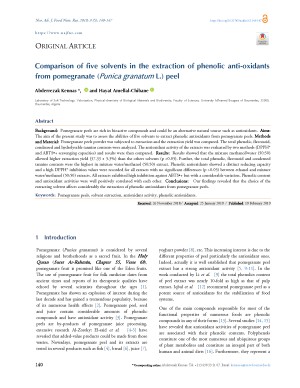
Comparison of Five Solvents in the Extraction of Phenolic Antioxidants from Pomegranate (Punica granatum L.) Peel
Copyright © 2019 Authors

This work is licensed under a Creative Commons Attribution 4.0 International License.
- Attribution — You must give appropriate credit, provide a link to the license, and indicate if changes were made.
- No additional restrictions — You may not apply legal terms or technological measures that legally restrict others from doing anything the license permits.


Background: Pomegranate peels are rich in bioactive compounds and could be an alternative natural source such as antioxidants.
Aims: The aim of the present study was to assess the abilities of five solvents to extract phenolic antioxidants from pomegranate peels.
Material and Methods: Pomegranate peels powder was subjected to extraction and the extraction yield was compared. The total phenolic, flavonoid, condensed and hydrolysable tannins contents were analyzed. The antioxidant activity of the extracts was evaluated by two methods (DPPH* and ABTS•+ scavenging capacities) and results were then compared.
Results: Results showed that the mixture methanol/water (50:50) allowed higher extraction yield (37.33 ± 5.3%) than the others solvents (p <0.05). Further, the total phenolic, flavonoid and condensed tannins contents were the highest in mixture water/methanol (50:50) extract. Phenolic antioxidants showed a distinct reducing capacity and a high DPPH* inhibition values were recorded for all extracts with no significant differences (p >0.05) between ethanol and mixture water/methanol (50:50) extracts. All extracts exhibited high inhibition against ABTS•+ but with a considerable variation. Phenolic content and antioxidant activities were well positively correlated with each other.
Conclusions: Our findings revealed that the choice of the extracting solvent affects considerably the extraction of phenolic antioxidants from pomegranate peels.
Keywords
How to Cite
1.
Viuda-Martos, M., Fernández-López, J., & Pérez-Álvarez, J. A. (2010). Pomegranate and its many functional components as related to human health: A review. Comprehensive Reviews in Food Science and Food Safety, 9(6), 635–654. https://doi.org/10.1111/j.1541-4337.2010.00131.x
2. Hasnaoui, N., Wathelet, B., & Jiménez-Araujo, A. (2014). Valorization of pomegranate peel from 12 cultivars: Dietary fibre composition, antioxidant capacity and functional properties. Food Chemistry, 160, 196–203. https://doi.org/10.1016/j.foodchem.2014.03.089
3. Derakhshan, Z., Ferrante, M., Tadi, M., Ansari, F., Heydari, A., Hosseini, M. S., Conti, G. O., & Sadarabad, E. K. (2018). Antioxidant activity and total phenolic content of ethanolic extract of pomegranate peels, juice and seeds. Food and Chemical Toxicology, 114, 108–111. https://doi.org/10.1016/j.fct.2018.02.023
4. Al-Zoreky, N. S. (2009). Antimicrobial activity of pomegranate (Punica granatum L.) fruit peels. International Journal of Food Microbiology, 134(3), 244–248. https://doi.org/10.1016/j.ijfoodmicro.2009.07.002
5. El-Said, M. M., Haggag, H. F., Fakhr El-Din, H. M., Gad, A. S., & Farahat, A. M. (2014). Antioxidant activities and physical properties of stirred yoghurt fortified with pomegranate peel extracts. Annals of Agricultural Sciences, 59(2), 207–212. https://doi.org/10.1016/j.aoas.2014.11.007
6. Altunkaya, A., Hedegaard, R. V., Brimer, L., Gokmen, V., & Skibsted, L. H. (2013). Antioxidant capacity versus chemical safety of wheat bread enriched with pomegranate peel powder. Food & Function, 4(5), 722–727. https://doi.org/10.1039/c3fo30296b
7. Ventura, J., Alarcón-Aguilar, F., Roman-Ramos, R., Campos-Sepulveda, E., Reyes-Vega, M. L., Boone-Villa, D., Jasso-Villagómez, E. I., & Aguilar, C. N. (2013). Quality and antioxidant properties of a reduced-sugar pomegranate juice jelly with an aqueous extract of pomegranate peels. Food Chemistry, 136(1), 109–115. https://doi.org/10.1016/j.foodchem.2012.07.039
8. Kennas, A., Amellal-Chibane, H., Kessal, F., & Halladj, F. (2018). Effect of pomegranate peel and honey fortification on physicochemical, physical, microbiological and antioxidant properties of yoghurt powder. Journal of the Saudi Society of Agricultural Sciences. Advance online publication. https://doi.org/10.1016/j.jssas.2018.07.001
9. Li, Y., Guo, C., Yang, J., Wei, J., Xu, J., & Cheng, S. (2006). Evaluation of antioxidant properties of pomegranate peel extract in comparison with pomegranate pulp extract. Food Chemistry, 96(2), 254–260. https://doi.org/10.1016/j.foodchem.2005.02.033
Similar Articles
- Phenolic Compounds and Antioxidant Activity of Different Parts of Three Mandarin Varieties Extracts: A Comparative Study
- Comparative Study of Total Phenolic Content and Antioxidant Proprieties of Quercus Fruit: Flour and Oil
- Ziziphus lotus (L.) Lam. plant treatment by ultrasounds and microwaves to improve antioxidants yield and quality: An overview
- Exploring the Antioxidant Potential and HPLC Profile of Fenugreek (Trigonella foenum-graecum L.) Seed Extracts
- Ultrasound as pre-treatment for microwave drying of Myrtus communis fruits: Influence on phenolic compounds and antioxidant activity
- In vitro, Antioxidant Activities of Aqueous and Methanol Roselle (Hibiscus sabdariffa) Calyces Extracts from Two Localities in Cameroon
- Polyvinyl Alcohol Films with Algerian Eruca vesicaria Extract as Natural Antioxidants for Food Packaging
- Microwave-Assisted Extraction Optimization and Conventional Extraction of Phenolic Compounds from Coriander Leaves: UHPLC Characterization and Antioxidant Activity
- Valorization and Optimization of Agro-Food By-Products from Punica granatum Bark and Juglans regia Husk Combined with Syzygium aromaticum for Enhanced Antioxidant and Anti-Inflammatory Activities: A D-Optimal Mixture Design Approach
- Assessment of Antioxidant and Antibacterial Activity of Phoenix dactylifera L. Seed Extracts: Perspective for the Development of New Foods
You may also start an advanced similarity search for this article.

 NAJFNR is licensed under