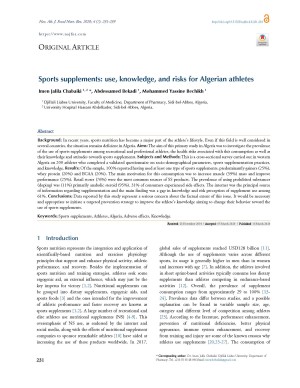
Sports Supplements: Use, Knowledge, and Risks for Algerian Athletes
Copyright © 2020 Authors

This work is licensed under a Creative Commons Attribution 4.0 International License.
- Attribution — You must give appropriate credit, provide a link to the license, and indicate if changes were made.
- No additional restrictions — You may not apply legal terms or technological measures that legally restrict others from doing anything the license permits.


Background: In recent years, sports nutrition has become a major part of the athlete’s lifestyle. Even if this field is well considered in several countries, the situation remains deficient in Algeria.
Aims: The aim of this primary study in Algeria was to investigate the prevalence of the use of sports supplements among recreational and professional athletes, the health risks associated with this consumption as well as their knowledge and attitudes towards sports supplements.
Subjects and Methods: This is a cross-sectional survey carried out in western Algeria on 200 athletes who completed a validated questionnaire on socio-demographical parameters, sports supplementation practices, and knowledge.
Results: Of the sample, 100% reported having used at least one type of sports supplements, predominantly gainers (25%), whey protein (20%) and BCAA (20%). The main motivation for this consumption was to increase muscle (59%) mass and improve performance (25%). Retail stores (76%) were the most common sources of SS products. The prevalence of using prohibited substances (doping) was (11%) primarily anabolic steroid (95%). 31% of consumers experienced side effects. The internet was the principal source of information regarding supplementation and the main finding was a gap in knowledge and risk perception of supplement use among 61%.
Conclusions: Data reported by this study represent a serious concern about the factual extent of this issue. It would be necessary and appropriate to initiate a targeted prevention strategy to improve the athlete’s knowledge aiming to change their behavior toward the use of sports supplements.
Keywords
How to Cite
1.
Thomas, D. T., Erdman, K. A., & Burke, L. M. (2016). Position of the Academy of Nutrition and Dietetics, Dietitians of Canada, and the American College of Sports Medicine: Nutrition and athletic performance. Journal of the Academy of Nutrition and Dietetics, 116(3), 501–528. https://doi.org/10.1016/j.jand.2015.12.006
2. Dunford, M., & Doyle, J. A. (2018). Nutrition for sport and exercise (4th ed.). Cengage Learning.
3. Tian, H. H., Ong, W. S., & Tan, C. L. (2009). Nutritional supplement use among university athletes in Singapore. Singapore Medical Journal, 50(2), 165–172.
4. Molinero, O., & Márquez, S. (2009). Use of nutritional supplements in sports: Risks, knowledge, and behavioural-related factors. Nutrición Hospitalaria, 24(2), 128–134.
5. Braun, H., Koehler, K., Geyer, H., Kleinert, J., Mester, J., & Schänzer, W. (2009). Dietary supplement use among elite young German athletes. International Journal of Sport Nutrition and Exercise Metabolism, 19(1), 97–109. https://doi.org/10.1123/ijsnem.19.1.97
6. Wiens, K., Erdman, K., Stadnyk, M., & Parnell, J. (2014). Dietary supplement usage, motivation, and education in young Canadian athletes. International Journal of Sport Nutrition and Exercise Metabolism, 24(6), 613–622. https://doi.org/10.1123/ijsnem.2013-0087
7. Knapik, J. J., Steelman, R. A., Hoedebecke, S. S., Austin, K. G., Farina, E. K., & Lieberman, H. R. (2016). Prevalence of dietary supplement use by athletes: Systematic review and meta-analysis. Sports Medicine, 46(1), 103–123. https://doi.org/10.1007/s40279-015-0387-7
8. Muwonge, H., Zavuga, R., Kabenge, P. A., & Makubuya, T. (2017). Nutritional supplement practices of professional Ugandan athletes: A cross-sectional study. Journal of the International Society of Sports Nutrition, 14(1), Article 41. https://doi.org/10.1186/s12970-017-0198-3
9. Maughan, R. J., Burke, L. M., Dvorak, J., Larson-Meyer, D. E., Peeling, P., Phillips, S. M., Rawson, E. S., Walsh, N. P., Garthe, I., Geyer, H., Meeusen, R., van Loon, L. J. C., Shirreffs, S. M., Spriet, L. L., Stuart, M., Vernec, A., Currell, K., Ali, V. M., Budgett, R. G., … Engebretsen, L. (2018). IOC consensus statement: Dietary supplements and the high-performance athlete. British Journal of Sports Medicine, 52(7), 439–455. https://doi.org/10.1136/bjsports-2018-099027
Similar Articles
- Pre-Exposure and Post-Exposure New Prophylactic Treatments Against COVID-19 in Healthcare Workers
- Effects of Extrusion on Nutritional and Non-Nutritional Properties in the Production of Multigrain Ready to Eat Snacks Incorporated with NUA45 Beans
- Needs-Based Development of an Experiential Food and Nutrition Education Curriculum for Middle School Students in Pakistan
- Impact of Micronutrient Supplementation on Sputum Conversion Kinetics in Pulmonary Tuberculosis: A Systematic Review and Meta-Analysis of Randomized Controlled Trials
- Determinant of Bioactive Compound Accumulation in Algerian Honey: A Comparative Physicochemical and Antioxidant Analysis of Urban and Mountainous Origins
- Impact of care group participation on nutrition knowledge, behaviour and practices
- Emerging Trends in Coffee Consumption Among University Students in Béjaïa, Algeria
- A review of traditional grain-based complementary foods for children aged 6-23 months in selected African countries
- Obesity Management in Women: Outcomes of a Nine-Month Individualized Nutritional and Behavioral Intervention Program: In Production
- Effects of Complementary Food Formulated from Millet, Soybean, and Grasshopper on Hematological Parameters of Malnourished Weanling Albino Rats
You may also start an advanced similarity search for this article.

 NAJFNR is licensed under