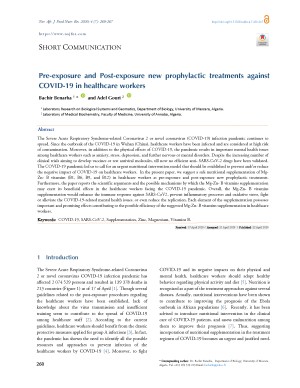
Pre-Exposure and Post-Exposure New Prophylactic Treatments Against COVID-19 in Healthcare Workers
Copyright © 2020 Authors

This work is licensed under a Creative Commons Attribution 4.0 International License.
- Attribution — You must give appropriate credit, provide a link to the license, and indicate if changes were made.
- No additional restrictions — You may not apply legal terms or technological measures that legally restrict others from doing anything the license permits.





The Severe Acute Respiratory Syndrome-related Coronavirus 2 or novel coronavirus (COVID-19) infection pandemic continues to spread. Since the outbreak of the COVID-19 in Wuhan (China), healthcare workers have been infected and are considered at high risk of contamination. Moreover, in addition to the physical effects of COVID-19, the pandemic results in important mental health issues among healthcare workers such as anxiety, stress, depression, and further nervous or mental disorders. Despite the increasing number of clinical trials aiming to develop vaccines or test antiviral molecules, till now no efficient anti- SARS-CoV-2 drugs have been validated. The COVID-19 pandemic led us to call for an urgent nutritional intervention model that should be established to prevent and/or reduce the negative impact of COVID-19 on healthcare workers. In the present paper, we suggest a safe nutritional supplementation of Mg-Zn- B vitamins (B1, B6, B9, and B12) in healthcare workers as pre-exposure and post-exposure new prophylactic treatments. Furthermore, the paper reports the scientific arguments and the possible mechanisms by which the Mg-Zn- B vitamins supplementation may exert its beneficial effects in the healthcare workers facing the COVID-19 pandemic. Overall, the Mg-Zn- B vitamins supplementation would enhance the immune response against SARS-CoV2, prevent inflammatory processes and oxidative stress, fight or alleviate the COVID-19-related mental health issues, or even reduce the replication. Each element of the supplementation possesses important and promising effects contributing to the possible efficiency of the suggested Mg-Zn- B vitamins supplementation in healthcare workers.
Keywords
How to Cite
1.
World Health Organization. (2020). Coronavirus disease 2019 (COVID-19): Situation report – 88. [No URL provided in original.]
2. Yu, J., Ding, N., Chen, H., Liu, X. J., He, W. J., Dai, W. C., Zhou, Z. G., Lin, F., Pu, Z. H., Li, D. F., Xu, H. J., Whang, Y. L., Zhang, H. W., & Lei, Y. (2020). Infection control against COVID-19 in departments of radiology. Academic Radiology. Advance online publication. https://doi.org/10.1016/j.acra.2020.03.025
3. National Health Commission of the People's Republic of China. (2020). Announcement of National Health Commission of the People's Republic of China: No. 1, 2020 [in Chinese]. http://www.nhc.gov.cn/jkj/s7916/202001/44a3b8245e8049d2837a4f27529cd386.shtml
4. Poole, D. N., Escudero, D. J., Gostin, L. O., Leblang, D., & Talbot, E. A. (2020). Responding to the COVID-19 pandemic in complex humanitarian crises. International Journal for Equity in Health, 19(1), Article 41. https://doi.org/10.1186/s12939-020-01162-y
5. Bansal, P., Bingemann, T. A., Greenhawt, M., Mosnaim, G., Nanda, A., Oppenheimer, J., Sharma, H., Stukus, D., & Shaker, M. (2020). Clinician wellness during the COVID-19 pandemic: Extraordinary times and unusual challenges for the allergist/immunologist. The Journal of Allergy and Clinical Immunology: In Practice. Advance online publication. https://doi.org/10.1016/j.jaip.2020.04.001
6. Laviano, A., Koverech, A., & Zanetti, M. (2020). Nutrition support in the time of SARS-CoV-2 (COVID-19). Nutrition, Article 110834. Advance online publication. https://doi.org/10.1016/j.nut.2020.110834
7. Khaled, M. B., & Benajiba, N. (2020). The role of nutrition in strengthening immune system against newly emerging viral diseases: Case of SARS-CoV-2. North African Journal of Food and Nutrition Research, 4(7), 240–244. https://doi.org/10.5281/zenodo.3749406
8. Wu, Y.-C., Chen, C.-S., & Chan, Y.-J. (2020). The outbreak of COVID-19: An overview. Journal of the Chinese Medical Association, 83(3), 217–220. https://doi.org/10.1097/JCMA.0000000000000270
9. Cheung, J. C.-H., Ho, L. T., Cheng, J. V., Cham, E. Y. K., & Lam, K. N. (2020). Staff safety during emergency airway management for COVID-19 in Hong Kong. The Lancet Respiratory Medicine, 8(4), e19. https://doi.org/10.1016/S2213-2600(20)30084-9
Similar Articles
- Nutritional Transitions and Determinants of Type 2 Diabetes Mellitus Among Indigenous Papuans in Indonesia: A Scoping Review: In Production
- Modeling of Nitrate Leaching Kinetics During Spinach Leaf Midribs Blanching
- Diet, Weight Status, and Physical Activity in Cancer Prevention
- Exploring the Interplay Between Social Media Addiction, Mindful Eating, Intuitive Eating, Orthorexia Nervosa, and Mental Health in Young Adults
- Abstract Book: First International Conference on Food Security and Sustainable Agri-food Technologies – ICFSSAT 2025
- Predatory Journals and Publishers at a Glance: Take Apart or Take Over?
- Statistical Study of the Relationship Between Hyperuricemia, Dyslipidemia and Type 2 Diabetes in Rural Population of Tizi-Ouzou, Algeria
- Prevalence of Type 2 Diabetes Mellitus in Africa: An Updated Narrative Review
- Effect of virgin olive and Pistacia lentiscus oils fortified with tomato lycopene on biochemical parameters in Wistar rats
- A review of traditional grain-based complementary foods for children aged 6-23 months in selected African countries
You may also start an advanced similarity search for this article.
Most read articles by the same author(s)
- Inhibitory Effect of Selenium Supplementation on Tumor Progression in a DMBA-Induced Breast Cancer Model in Wistar Rats
- New Insight on Nutrition and COVID-19 Pandemic
- Enhancing Food Security Through Scientific Research in Algeria. A Novel Vision and Unified National Strategy
- Phytochemical Analysis, Antioxidant and Anti-Candida albicans Activities of Annona cherimola Mill. Fruit Pulp
- Impact of Sociodemographic, Reproductive, and Lifestyle Factors on Breast Cancer Risk in Northwestern Algeria: A Case-Control Study: In Production

 NAJFNR is licensed under