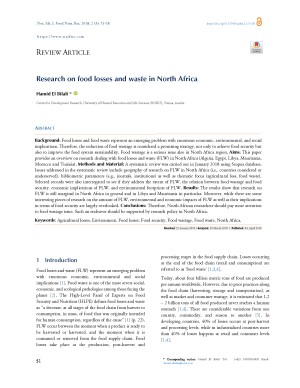
Research on Food Losses and Waste in North Africa
Copyright © 2018 Authors

This work is licensed under a Creative Commons Attribution 4.0 International License.
- Attribution — You must give appropriate credit, provide a link to the license, and indicate if changes were made.
- No additional restrictions — You may not apply legal terms or technological measures that legally restrict others from doing anything the license permits.





Background: Food losses and food waste represent an emerging problem with enormous economic, environmental, and social implications. Therefore, the reduction of food wastage is considered a promising strategy, not only to achieve food security but also to improve the food system sustainability. Food wastage is a serious issue also in North Africa region.
Aims: This paper provides an overview on research dealing with food losses and waste (FLW) in North Africa (Algeria, Egypt, Libya, Mauritania, Morocco and Tunisia).
Material and Methods: A systematic review was carried out in January 2018 using Scopus database. Issues addressed in the systematic review include geography of research on FLW in North Africa (i.e. countries considered or underserved), bibliometric parameters (e.g. journals, institutions) as well as thematic focus (agricultural loss, food waste). Selected records were also interrogated to see if they address the extent of FLW, the relation between food wastage and food security, economic implications of FLW, and environmental footprints of FLW.
Results: The results show that research on FLW is still marginal in North Africa in general and in Libya and Mauritania in particular. Moreover, while there are some interesting pieces of research on the amount of FLW, environmental and economic impacts of FLW as well as their implications in terms of food security are largely overlooked.
Conclusions: Therefore, North African researchers should pay more attention to food wastage issue. Such an endeavor should be supported by research policy in North Africa.
Keywords
How to Cite
1.
High Level Panel of Experts on Food Security and Nutrition. (2014). Food losses and waste in the context of sustainable food systems. Food and Agriculture Organization of the United Nations. http://www.fao.org/3/a-i3901e.pdf
2. Waste & Resources Action Programme. (2008). The food we waste. WRAP. http://www.wrap.org.uk/downloads/The_Food_We_Waste_v2__2_.99cb5cae.5635.pdf
3. Parfitt, J., Barthel, M., & Macnaughton, S. (2010). Food waste within food supply chains: Quantification and potential for change to 2050. Philosophical Transactions of the Royal Society B: Biological Sciences, 365(1554), 3065–3081. https://doi.org/10.1098/rstb.2010.0126
4. Food and Agriculture Organization of the United Nations. (2011). Global food losses and food waste: Extent, causes and prevention. FAO. https://doi.org/10.1098/rstb.2010.0126
5. Lundqvist, J. (2010). Producing more or wasting less? Bracing the food security challenge of unpredictable rainfall. In L. Martínez-Cortina, G. Garrido, & L. López-Gunn (Eds.), Re-thinking water and food security: Fourth Marcelino Botín Foundation Water Workshop (pp. 75–92). Taylor & Francis Group. https://doi.org/10.1201/b10541
6. Xue, L., Liu, G., Parfitt, J., Liu, X., Van Herpen, E., Stenmarck, Å., O'Connor, C., Östergren, K., & Cheng, S. (2017). Missing food, missing data? A critical review of global food losses and food waste data. Environmental Science & Technology, 51(12), 6618–6633. https://doi.org/10.1021/acs.est.7b00401
7. Chaboud, G., & Daviron, B. (2017). Food losses and waste: Navigating the inconsistencies. Global Food Security, 12, 1–7. https://doi.org/10.1016/j.gfs.2016.11.004
8. Food and Agriculture Organization of the United Nations. (2013). Food wastage footprint: Impacts on natural resources—Summary report. FAO.
9. Gorski, I., Siddiqi, S., & Neff, R. (2017). Governmental plans to address waste of food. Johns Hopkins Center for a Livable Future. https://www.jhsph.edu/research/centers-and-institutes/johns-hopkins-center-for-a-livable-future/_pdf/projects/wasted-food/governmental-plans-to-address-waste-of-food.pdf
Similar Articles
- The Role of Barley, Sorghum, Rice, and Maize in North African Cuisine
- Hepatorenal and Cerebral Toxicity Induced by Consumption of Cow Meat Singed with Scrap Tyres: An Experimental Study in a Rat Model
- Food and Water Security in Developing Economies: Impact of the Pandemic and Possible Interventions
- Olive Stone as a Sustainable Agricultural By-Product: Valorization Pathways and Prospects in Food and Feed Industries
- COVID-19 lockdown impact on Tunisian consumer behaviors and awareness related to food consumption and wastage during celebrations: Case of study “Ramadan month”
- Natural Pectin Sources, Extraction Methods, Chemical Composition, and Emerging Applications in Food Systems: A Systematic Review
- Climate-Resilient Crops as Gluten-Free Substitutes: A Systematic Review of the Nutritional, Technofunctional, and Rheological Properties of Sorghum, Pearl Millet, and Amaranth
- Nutritional Optimization and Sensory Characterization of Cookies Via Pearl Millet (Pennisetum glaucum) Flour Substitution: A Multivariate Analytical Approach
- Household production and energy content of infant flours for children aged 6 to 11 months in two rural settings in southern Benin
- Risk Factors Associated with Severe Acute Malnutrition (SAM) in Children Aged 6 – 59 Months in the Mokolo Health District, Far North Region of Cameroon
You may also start an advanced similarity search for this article.

 NAJFNR is licensed under