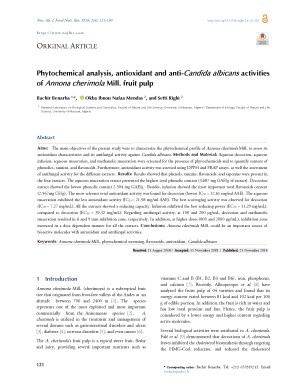
Phytochemical Analysis, Antioxidant and Anti-Candida albicans Activities of Annona cherimola Mill. Fruit Pulp
Copyright © 2018 Authors

This work is licensed under a Creative Commons Attribution 4.0 International License.
- Attribution — You must give appropriate credit, provide a link to the license, and indicate if changes were made.
- No additional restrictions — You may not apply legal terms or technological measures that legally restrict others from doing anything the license permits.


Aims: The main objectives of the present study were to characterize the phytochemical profile of Annona cherimola Mill, to assess its antioxidant characteristics and its antifungal activity against Candida albicans.
Material and Methods: Aqueous decoction, aqueous infusion, aqueous maceration, and methanolic maceration were screened for the presence of phytochemicals and to quantify content of phenolics, tannins, and flavonoids. Furthermore, antioxidant activity was assessed using DPPH and FRAP assays, as well the assessment of antifungal activity for the different extracts.
Results: Results showed that phenols, tannins, flavonoids, and saponins were present in the four extracts. The aqueous maceration extract presented the highest total phenolic content (3.687 mg GAE/g of extract). Decoction extract showed the lowest phenolic content 2.504 mg GAE/g. Besides, infusion showed the most important total flavonoids content (2.567mg CE/g). The most relevant total antioxidant activity was found for decoction (lowest IC50 12.61 mg/ml AAE). The aqueous maceration exhibited the less antioxidant activity (IC50= 21.98 mg/ml AAE). The best scavenging activity was observed for decoction (IC50=7.27 mg/mL). All the extracts showed a reducing capacity. Infusion exhibited the best reducing power (EC50 = 11.29 mg/mL), compared to decoction (EC50 = 39.32 mg/mL). Regarding antifungal activity, at 100 and 200 µg/mL, decoction and methanolic maceration resulted in 6 and 9 mm inhibition zone, respectively. In addition, at higher doses (800 and 2000 µg/mL), inhibition zone increased in a dose dependent manner for all the extracts.
Conclusions: Annona cherimola Mill. could be an important source of bioactive molecules with antioxidant and antifungal activities.
Keywords
How to Cite
1.
Pino, J. A. (2010). Annona fruits. In Y. H. Hui (Ed.), Handbook of fruit and vegetable flavors (pp. 231–247). John Wiley & Sons. https://doi.org/10.1002/9780470547847.ch14
2. Vanhove, W., & Van Damme, P. (2013). Value chains of cherimoya (Annona cherimola Mill.) in a centre of diversity and its on-farm conservation implications. Tropical Conservation Science, 6(2), 158–180. https://doi.org/10.1177/194008291300600203
3. Velázquez, C., Calzada, F., Torres, J., González, F., & Ceballos, G. (2006). Antisecretory activity of plants used to treat gastrointestinal disorders in Mexico. Journal of Ethnopharmacology, 103(1), 66–70. https://doi.org/10.1016/j.jep.2005.06.046
4. Andrade-Cetto, A., & Heinrich, M. (2005). Mexican plants with hypoglycaemic effect used in the treatment of diabetes. Journal of Ethnopharmacology, 99(3), 325–348. https://doi.org/10.1016/j.jep.2005.04.019
5. Auditeau, E., Moyano, L. M., Bourdy, G., Nizard, M., Jost, J., Ratsimbazafy, V., Preux, P. M., & Boumediene, F. (2018). Herbal medicine uses to treat people with epilepsy: A survey in rural communities of northern Peru. Journal of Ethnopharmacology, 215, 184–190. https://doi.org/10.1016/j.jep.2018.01.003
6. Graham, J. G., Quinn, M. L., Fabricant, D. S., & Farnsworth, N. R. (2000). Plants used against cancer—An extension of the work of Jonathan Hartwell. Journal of Ethnopharmacology, 73(3), 347–377. https://doi.org/10.1016/S0378-8741(00)00341-X
7. Jamkhande, P. G., Ajgunde, B. R., & Jadge, D. R. (2017). Annona cherimola Mill. (Custard apple): A review on its plant profile, nutritional values, traditional claims and ethnomedicinal properties. Oriental Pharmacy and Experimental Medicine, 17(3), 189–201. https://doi.org/10.1007/s13596-017-0263-0
8. Albuquerque, T. G., Santos, F., Sanches-Silva, A., Oliveira, M. B., Bento, A. C., & Costa, H. S. (2016). Nutritional and phytochemical composition of Annona cherimola Mill. fruits and by-products: Potential health benefits. Food Chemistry, 193, 187–195. https://doi.org/10.1016/j.foodchem.2014.06.044
9. Falé, P. L., Ferreira, C., Maruzzella, F., Florêncio, M. H., Frazão, F. N., & Serralheiro, M. L. (2013). Evaluation of cholesterol absorption and biosynthesis by decoctions of Annona cherimola leaves. Journal of Ethnopharmacology, 150(2), 718–723. https://doi.org/10.1016/j.jep.2013.09.029
Similar Articles
- The relationship between nutrition screenings and nutritional status determined by malnutrition in hemodialysis patients
- Randomized, Placebo-Controlled Pilot Study Investigating the Effects of Laurus nobilis Tea on Lipid Profiles and Oxidative Stress Biomarkers in Healthy North African Volunteers
- Phenol Content, Potential Antioxidant and Anti-Urolithic Effects of Fruit and Leaf Extracts from Algerian Capparis spinosa L.
- Physicochemical, Biochemical, Microbiological, and Sensory Characterization of a Fermented Lima Bean (Phaseolus lunatus) Probiotic Beverage During Refrigerated Storage
- Comparison of Five Solvents in the Extraction of Phenolic Antioxidants from Pomegranate (Punica granatum L.) Peel
- Statistical Optimization of Microwave-Assisted Extraction of Phytochemicals from Retama raetam (White Weeping Broom) Twigs and their Biological Properties
- Polyvinyl Alcohol Films with Algerian Eruca vesicaria Extract as Natural Antioxidants for Food Packaging
- Evaluation of Hematological and Biochemical Parameters of Liver Function Following Consumption of Vitex doniana Fruit Syrup
- Effects of Beetroot and Pomegranate Juice Supplementation on Creatine Kinase and C-Reactive Protein in Amateur Soccer Players
- Bioactive Molecules of Grape
You may also start an advanced similarity search for this article.
Most read articles by the same author(s)
- The Inhibitory Effect of Selenium Supplementation on Tumor Progression in a DMBA-Induced Breast Cancer Model in Wistar Rats
- Pre-Exposure and Post-Exposure New Prophylactic Treatments Against COVID-19 in Healthcare Workers
- New Insight on Nutrition and COVID-19 Pandemic
- Enhancing Food Security Through Scientific Research in Algeria. A Novel Vision and Unified National Strategy
- The Impact of Sociodemographic, Reproductive and Lifestyle Factors on Breast Cancer Risk in Northwestern Algeria: A Case-Control StudyTop of Form

 NAJFNR is licensed under