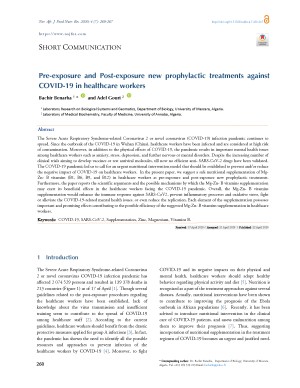
Pre-Exposure and Post-Exposure New Prophylactic Treatments Against COVID-19 in Healthcare Workers
Copyright © 2020 Authors

This work is licensed under a Creative Commons Attribution 4.0 International License.
- Attribution — You must give appropriate credit, provide a link to the license, and indicate if changes were made.
- No additional restrictions — You may not apply legal terms or technological measures that legally restrict others from doing anything the license permits.





The Severe Acute Respiratory Syndrome-related Coronavirus 2 or novel coronavirus (COVID-19) infection pandemic continues to spread. Since the outbreak of the COVID-19 in Wuhan (China), healthcare workers have been infected and are considered at high risk of contamination. Moreover, in addition to the physical effects of COVID-19, the pandemic results in important mental health issues among healthcare workers such as anxiety, stress, depression, and further nervous or mental disorders. Despite the increasing number of clinical trials aiming to develop vaccines or test antiviral molecules, till now no efficient anti- SARS-CoV-2 drugs have been validated. The COVID-19 pandemic led us to call for an urgent nutritional intervention model that should be established to prevent and/or reduce the negative impact of COVID-19 on healthcare workers. In the present paper, we suggest a safe nutritional supplementation of Mg-Zn- B vitamins (B1, B6, B9, and B12) in healthcare workers as pre-exposure and post-exposure new prophylactic treatments. Furthermore, the paper reports the scientific arguments and the possible mechanisms by which the Mg-Zn- B vitamins supplementation may exert its beneficial effects in the healthcare workers facing the COVID-19 pandemic. Overall, the Mg-Zn- B vitamins supplementation would enhance the immune response against SARS-CoV2, prevent inflammatory processes and oxidative stress, fight or alleviate the COVID-19-related mental health issues, or even reduce the replication. Each element of the supplementation possesses important and promising effects contributing to the possible efficiency of the suggested Mg-Zn- B vitamins supplementation in healthcare workers.
Keywords
How to Cite
1.
World Health Organization. (2020). Coronavirus disease 2019 (COVID-19): Situation report – 88. [No URL provided in original.]
2. Yu, J., Ding, N., Chen, H., Liu, X. J., He, W. J., Dai, W. C., Zhou, Z. G., Lin, F., Pu, Z. H., Li, D. F., Xu, H. J., Whang, Y. L., Zhang, H. W., & Lei, Y. (2020). Infection control against COVID-19 in departments of radiology. Academic Radiology. Advance online publication. https://doi.org/10.1016/j.acra.2020.03.025
3. National Health Commission of the People's Republic of China. (2020). Announcement of National Health Commission of the People's Republic of China: No. 1, 2020 [in Chinese]. http://www.nhc.gov.cn/jkj/s7916/202001/44a3b8245e8049d2837a4f27529cd386.shtml
4. Poole, D. N., Escudero, D. J., Gostin, L. O., Leblang, D., & Talbot, E. A. (2020). Responding to the COVID-19 pandemic in complex humanitarian crises. International Journal for Equity in Health, 19(1), Article 41. https://doi.org/10.1186/s12939-020-01162-y
5. Bansal, P., Bingemann, T. A., Greenhawt, M., Mosnaim, G., Nanda, A., Oppenheimer, J., Sharma, H., Stukus, D., & Shaker, M. (2020). Clinician wellness during the COVID-19 pandemic: Extraordinary times and unusual challenges for the allergist/immunologist. The Journal of Allergy and Clinical Immunology: In Practice. Advance online publication. https://doi.org/10.1016/j.jaip.2020.04.001
6. Laviano, A., Koverech, A., & Zanetti, M. (2020). Nutrition support in the time of SARS-CoV-2 (COVID-19). Nutrition, Article 110834. Advance online publication. https://doi.org/10.1016/j.nut.2020.110834
7. Khaled, M. B., & Benajiba, N. (2020). The role of nutrition in strengthening immune system against newly emerging viral diseases: Case of SARS-CoV-2. North African Journal of Food and Nutrition Research, 4(7), 240–244. https://doi.org/10.5281/zenodo.3749406
8. Wu, Y.-C., Chen, C.-S., & Chan, Y.-J. (2020). The outbreak of COVID-19: An overview. Journal of the Chinese Medical Association, 83(3), 217–220. https://doi.org/10.1097/JCMA.0000000000000270
9. Cheung, J. C.-H., Ho, L. T., Cheng, J. V., Cham, E. Y. K., & Lam, K. N. (2020). Staff safety during emergency airway management for COVID-19 in Hong Kong. The Lancet Respiratory Medicine, 8(4), e19. https://doi.org/10.1016/S2213-2600(20)30084-9
Similar Articles
- Nutrition and Food Security in Mali From 2010 to 2020
- Food and Water Security in Developing Economies: Impact of the Pandemic and Possible Interventions
- Examination of traditional fermented food consumption and product awareness of university students in Istanbul, Turkey
- Quantitative and Qualitative Assessment of Food Waste in Rural Markets in Morocco
- Nutritional Quality Assessment and Dietary Diversity of Food in Collective Catering: A Study in Al Hoceima Province, Morocco
- Screening of Five Lactobacillus Bacteria with Probiotic Properties from Indigenous Klila Cheese
- Natural Pectin Sources, Extraction Methods, Chemical Composition, and Emerging Applications in Food Systems: A Systematic Review
- Age-Dependent Parameters of the Von Bertalanffy (1938) Growth Model: A Case Study of Sardinella aurita (Valenciennes, 1847) along the Central Algerian Coast (Southeastern Mediterranean Sea)
- Abstract Book: 1st International Congress on Sustainable Food Security (SFS) : Innovation and Challenges (2025)
- Determination of Isoflavones from Soy-Milk, Masoor and Mung Dal Soups in Bangladeshi Postmenopausal Women
You may also start an advanced similarity search for this article.
Most read articles by the same author(s)
- Inhibitory Effect of Selenium Supplementation on Tumor Progression in a DMBA-Induced Breast Cancer Model in Wistar Rats
- New Insight on Nutrition and COVID-19 Pandemic
- Enhancing Food Security Through Scientific Research in Algeria. A Novel Vision and Unified National Strategy
- Phytochemical Analysis, Antioxidant and Anti-Candida albicans Activities of Annona cherimola Mill. Fruit Pulp
- Impact of Sociodemographic, Reproductive, and Lifestyle Factors on Breast Cancer Risk in Northwestern Algeria: A Case-Control Study: In Production

 NAJFNR is licensed under