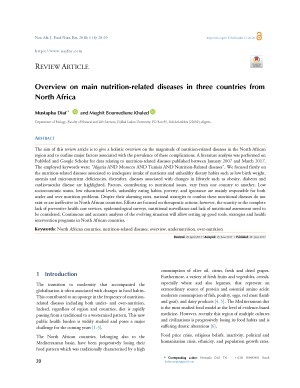
Overview on Main Nutrition-Related Diseases in Three Countries from North Africa
Copyright © 2017 Authors

This work is licensed under a Creative Commons Attribution 4.0 International License.
- Attribution — You must give appropriate credit, provide a link to the license, and indicate if changes were made.
- No additional restrictions — You may not apply legal terms or technological measures that legally restrict others from doing anything the license permits.


The aim of this review article is to provide a holistic overview on the magnitude of nutrition-related diseases in the North African region and to outline major factors associated with the prevalence of these complications. A literature analysis was performed on PubMed and Google Scholar for data relating to nutrition-related diseases published between January 2007 and March 2017. The employed keywords were; “Algeria AND Morocco AND Tunisia AND Nutrition-Related diseases”. We focused firstly on the nutrition-related diseases associated to inadequate intake of nutrients and unhealthy dietary habits such as low birth weight, anemia and micronutrient deficiencies, thereafter, diseases associated with changes in lifestyle such as obesity, diabetes and cardiovascular disease are highlighted.
Factors contributing to nutritional problems vary from country to another. Low socioeconomic status, low educational levels, unhealthy eating habits, poverty and ignorance are mainly responsible for both under and over nutrition problems. Despite their alarming rates, national strategies to combat these nutritional diseases do not exist or are ineffective in North African countries. Efforts are focused on therapeutic actions, however, the scarcity or the complete lack of preventive health care services, epidemiological surveys, nutritional surveillance and lack of nutritional assessment need to be considered. Continuous and accurate analyses of the evolving situation will allow setting up a good tools, strategies and health intervention programs in North African countries.
Keywords
How to Cite
1.
Aboul-Enein, B. H., Bernstein, J., & Neary, A. C. (2017). Dietary transition and obesity in selected Arabic-speaking countries: A review of the current evidence. Eastern Mediterranean Health Journal, 22(10), 763–770.
2. Belahsen, R. (2014). Nutrition transition and food sustainability. Proceedings of the Nutrition Society, 73(3), 385–388. https://doi.org/10.1017/S0029665114000135
3. Rahim, H. F., Sibai, A., Khader, Y., Hwalla, N., Fadhil, I., Alsiyabi, H., Mataria, A., Mendis, S., Mokdad, A. H., & Husseini, A. (2014). Non-communicable diseases in the Arab world. The Lancet, 383(9914), 356–367. https://doi.org/10.1016/S0140-6736(13)62383-1
4. Martínez-González, M. A., Salas-Salvadó, J., Estruch, R., Corella, D., Fitó, M., & Ros, E. (2015). Benefits of the Mediterranean diet: Insights from the PREDIMED study. Progress in Cardiovascular Diseases, 58(1), 50–60. https://doi.org/10.1016/j.pcad.2015.04.003
5. Davis, C., Bryan, J., Hodgson, J., & Murphy, K. (2015). Definition of the Mediterranean diet: A literature review. Nutrients, 7(11), 9139–9153. https://doi.org/10.3390/nu7115459
6. Grigg, D. (1999). Food consumption in the Mediterranean region. Tijdschrift voor Economische en Sociale Geografie, 90(4), 391–409. https://doi.org/10.1111/1467-9663.00081
7. Bagchi, K. (2004). Iron deficiency anaemia—An old enemy. Eastern Mediterranean Health Journal, 10(6), 754–760.
8. Landais, E., Bour, A., Gartner, A., McCullough, F., Delpeuch, F., & Holdsworth, M. (2015). Socio-economic and behavioural determinants of fruit and vegetable intake in Moroccan women. Public Health Nutrition, 18(5), 809–816. https://doi.org/10.1017/S1368980014001761
9. Beltaïfa, L., Traissac, P., El Ati, J., Lefèvre, P., Romdhane, H. B., & Delpeuch, F. (2009). Prevalence of obesity and associated socioeconomic factors among Tunisian women from different living environments. Obesity Reviews, 10(2), 145–153. https://doi.org/10.1111/j.1467-789X.2008.00543.x
Similar Articles
- Zero hunger and malnutrition in the African continent is potentially feasible, if nutrition programs are prioritized politically and scientifically
- Research on Food Losses and Waste in North Africa
- An overview on the nutrition transition and its health implications: Tunisia case
- Understanding Bread Consumption and Waste Patterns in Algeria and Tunisia: Insights into Consumer Practices and Challenges
- From Storage to Disposal: An Investigation of Household Bread Management and Waste in Algeria and Tunisia
- Editorial from the New Editor-in-Chief and the New Executive Deputy Editors-in-Chief
- A review of traditional grain-based complementary foods for children aged 6-23 months in selected African countries
- An update of the nutritional situation in eastern Algeria
- Update of the Nutrition Situation in Nigeria
- The Role of Barley, Sorghum, Rice, and Maize in North African Cuisine
You may also start an advanced similarity search for this article.
Most read articles by the same author(s)
- Understanding Bread Consumption and Waste Patterns in Algeria and Tunisia: Insights into Consumer Practices and Challenges
- The Role of Nutrition in Strengthening Immune System Against Newly Emerging Viral Diseases: Case of SARS-CoV-2
- Epidemiology, diagnosis, and assessment of diabetes mellitus in the elderly population: a purposive review
- Predatory Journals and Publishers at a Glance: Take Apart or Take Over?
- From Storage to Disposal: An Investigation of Household Bread Management and Waste in Algeria and Tunisia
- Physicochemical Quality Assessment of Brazilian Frozen Beef Imported Into Algeria
- Metabolic Syndrome and Risk of Colorectal Adenoma and Colorectal Cancer: A Meta-Analysis
- Metabolic Syndrome Components Correlation with Colorectal Neoplasms: A Systematic Review and a Meta-Analysis
- Ameliorative Effects of Citrus aurantium Juice on Metabolic Disorders Induced by Trans Fatty Acid-Rich Amalgam in Wistar rats
- New insight on nutrition and COVID-19 pandemic

 NAJFNR is licensed under