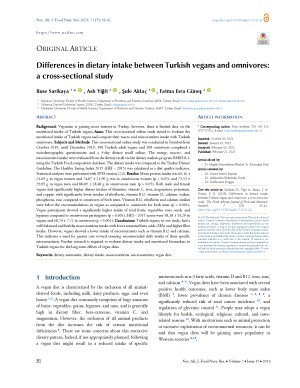
Differences in Dietary Intake Between Turkish Vegans and Omnivores: A Cross-Sectional Study
Copyright © 2023 Buse Sarıkaya, Aslı Yiğit, Şule Aktaç, Fatma Esra Güneş

This work is licensed under a Creative Commons Attribution 4.0 International License.
- Attribution — You must give appropriate credit, provide a link to the license, and indicate if changes were made.
- No additional restrictions — You may not apply legal terms or technological measures that legally restrict others from doing anything the license permits.


Background: Veganism is gaining more interest in Turkey, however, there is limited data on the nutritional intake of Turkish vegans.
Aims: This cross-sectional online study aimed to evaluate the nutritional intake of Turkish vegans and compare their macro and micronutrient intake with Turkish omnivores.
Subjects and Methods: This cross-sectional online study was conducted in İstanbul from October 2019, until December 2019. 108 Turkish adult vegans and 108 omnivores completed a sociodemographic questionnaire and a 3-day dietary recall online. The energy, macro-, and micronutrient intake were evaluated from the dietary recall via the dietary analysis program BEBIS 8.1, using the Turkish Food composition database. The dietary intake was compared to the Turkey Dietary Guideline. The Healthy Eating Index 2015 (HEI – 2015) was calculated as a diet quality indicator. Statistical analyses were performed with SPSS version 22.0.
Results: Mean protein intake was 66.16 ± 21.69 g in vegan women and 74.87 ± 21.90 g was in omnivorous women (p < 0.05), and 75.53 ± 29.09 g in vegan men and 88.89 ± 28.48 g in omnivorous men (p > 0.05). Both male and female vegans had significantly higher dietary intakes of thiamine, vitamin C, iron, magnesium, potassium, and copper; with significantly lower intakes of riboflavin, vitamin B12, vitamin D, calcium, iodine, phosphorus, zinc compared to omnivores of both sexes. Vitamin B12, riboflavin and calcium intakes were below the recommendations in vegans as compared to omnivores for both sexes (p < 0.001). Vegan participants showed a significantly higher intake of total fruits, vegetables, nuts, seeds, and legumes compared to omnivorous participants (p < 0.001). HEI – 2015 scores were 58.18 ± 13.20 in vegans and 68.74 ± 7.72 in omnivores (p < 0.001).
Conclusions: Turkish vegans, in our study, had a well-balanced and healthy macronutrient intake with lower saturated fatty acids (SFA) and higher fiber intake. However, vegans showed a lower intake of micronutrients such as vitamin B12 and calcium. This indicates a need for greater care toward ensuring recommended daily intake of these specific micronutrients. Further research is required to evaluate dietary intake and nutritional biomarkers in Turkish vegans for the long-term effects of vegan diets.
Keywords
How to Cite
Similar Articles
- Impact of Micronutrient Supplementation on Sputum Conversion Kinetics in Pulmonary Tuberculosis: A Systematic Review and Meta-Analysis of Randomized Controlled Trials
- A review of traditional grain-based complementary foods for children aged 6-23 months in selected African countries
- Effect of Polysaccharide-Coatings on the Physicochemical Properties and Nutritional Composition of Deep-Fried Chicken Breasts
- Translation, Cultural Adaptation, and Validation of the Arabic Version of the STRONGkids Nutrition Screening Tool in the Moroccan Pediatric Clinical Setting
- Understanding Bread Consumption and Waste Patterns in Algeria and Tunisia: Insights into Consumer Practices and Challenges
- Physicochemical Quality Assessment of Brazilian Frozen Beef Imported Into Algeria
- A UV-Visible Spectrophotometric Approach to Quantify Caffeine and Carbohydrates in Dhaka's Chocolate and Candy Selection, Bangladesh
- Evaluation of Nutritional Status Among COVID-19 Patients Admitted to the Intensive Care Unit in Jeddah, Saudi Arabia: A Cross-Sectional Observational Study
- In vitro, Antioxidant Activities of Aqueous and Methanol Roselle (Hibiscus sabdariffa) Calyces Extracts from Two Localities in Cameroon
- Nutritional status among pregnant adolescents at maternity teaching hospital
You may also start an advanced similarity search for this article.
Most read articles by the same author(s)
- Quality of life, perceived stress and nutrition of patients with irritable bowel syndrome: A descriptive study
- Examination of traditional fermented food consumption and product awareness of university students in Istanbul, Turkey
- Investigation of Total Aflatoxin in Nuts and Dried Fruits and Consumption Habits During Pregnancy in Türkiye

 NAJFNR is licensed under